INTRODUCTION
Acute appendicitis is an inflammation that arises suddenly in the appendix and one case of acute abdomen is most frequently encountered. Acute Appendicitis is an inflammation of the bacteria that triggered a variety of factors. Among lymphoid tissue hyperplasia, fekalith, appendix tumor and Ascaris worms can also cause penyumbatan.
The incidence of acute appendicitis is higher in developed countries than developing countries, but in three to four decades decreased significantly, ie 100 cases per 100,000 population form the 52 per 100,000 population. This incident may be due to dietary changes, namely the developing countries become less fiber foods.According to epidemiological data of acute appendicitis is rare in infants, increasing at puberty, and reached its peak during adolescence and early 20s, whereas this figure decreased in adulthood. The incidence of appendicitis as much between women and men during prapuber, whereas in adolescence and young adulthood ratio becomes 3:2, then these high numbers decreased in pria.1
From various studies have been conducted, obstruction is the cause of the dominant and is the trigger for the occurrence of appendicitis. Germs that are normal flora of the intestine can become pathogenic, according to Schwartz germs leading cause of acute appendicitis is a common fragilis Bacteriodes E.coli.
REVIEW REFERENCES
Appendix Verniformis
Definition Appendix
Appendix is an organ found in the cecum located in the proximal colon, which until now its function has not diketahui.1
Anatomy
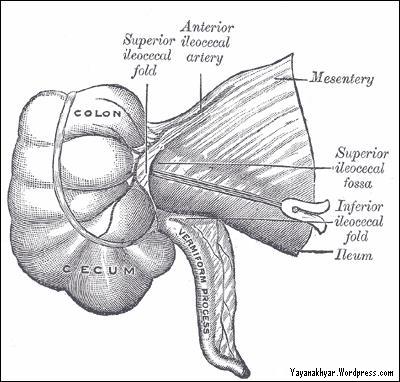
Appendix is an organ-shaped tube with a length of approximately 10cm and stem from the cecum. The appendix has a narrow lumen proximal section and wide in the distal. At birth, short and wide dipersambungan appendix with the cecum. During the children, growth usually rotates into retrocaecal but still in the intraperitoneal. In the appendix there are 3 tanea coli fused dipersambungan caecum and could be useful in indicating where to detect the appendix. The position of the appendix is most Retrocaecal (74%) and then following a pelvic (21%), Patileal (5%), Paracaecal (2%), subcaecal (1.5%) and preleal (1%) .1,4
Appendix give blood by apendicular arteries that branch of the artery carrying ileocolica. Artery appendix includes end arteries. The appendix has more than 6 mesoapendiks obstruct lymph channels to the lymph nodes ileocaecal.3
Anatomical location of the appendix
Physiological
Although the appendix-less has a function, but the appendix could function like any other organ. Appendix produces mucus 1-2ml per day. Lenders poured into the caecum. If there is resistance there will be a pathogenesis of acute appendicitis. Galt (Assoiated Gut lymphoid tissue) contained in the appendix to produce Ig-A. however, if the appendix removed, none affect the body's immune system because there are very few.
For read more can be download at: